
A precise understanding of foundational concepts is essential in implantology, especially when treating patients with severe bone atrophy.
Before considering a subperiosteal implant as a treatment option, clinicians must clearly understand what “subperiosteal” means, how this approach differs from conventional implantology, and why its anatomical and biomechanical principles directly influence planning, surgical execution, and long-term outcomes.
The subperiosteal approach is not simply an alternative implant technique. It is a patient-specific solution that requires careful diagnosis, digital planning, prosthetic anticipation, soft tissue management, and a clear understanding of the interface between bone, periosteum, framework, and mucosa.
- 1 Understanding the subperiosteal concept
- 2 Why the definition influences patient selection ?
- 3 A different approach from conventional implants
- 4 Digital planning and custom design
- 5 Soft tissue management and risk control
- 6 Treatment timelines and rehabilitation
- 7 The importance of training and structured learning
- 8 From definition to clinical expertise
- 9 Conclusion
Understanding the subperiosteal concept
The term “subperiosteal” refers to the anatomical space beneath the periosteum, the connective tissue layer that covers bone. In implantology, a subperiosteal implant is a custom-made framework designed to rest on the surface of the jawbone, beneath the periosteum and soft tissues. This differs from endosseous implants, which are inserted directly into the bone.
This distinction is fundamental. Conventional implants depend on sufficient bone height, width, and density to achieve primary stability within the jawbone. Subperiosteal implants, by contrast, are designed to sit on the bone surface and are stabilized according to a patient-specific plan.
This makes them particularly relevant in cases where the residual bone volume is too limited for standard implant placement without extensive augmentation.
Understanding this definition helps clinicians avoid oversimplifying the procedure. A subperiosteal implant is not merely an implant “placed on bone.” It is a custom-designed structure that must be adapted to the patient’s anatomy, prosthetic needs, occlusal forces, and soft tissue conditions.
Why the definition influences patient selection ?
A clear understanding of the subperiosteal concept is essential for selecting the right patients. This approach is generally considered in complex cases where conventional implant solutions are limited or unsuitable due to advanced bone resorption.
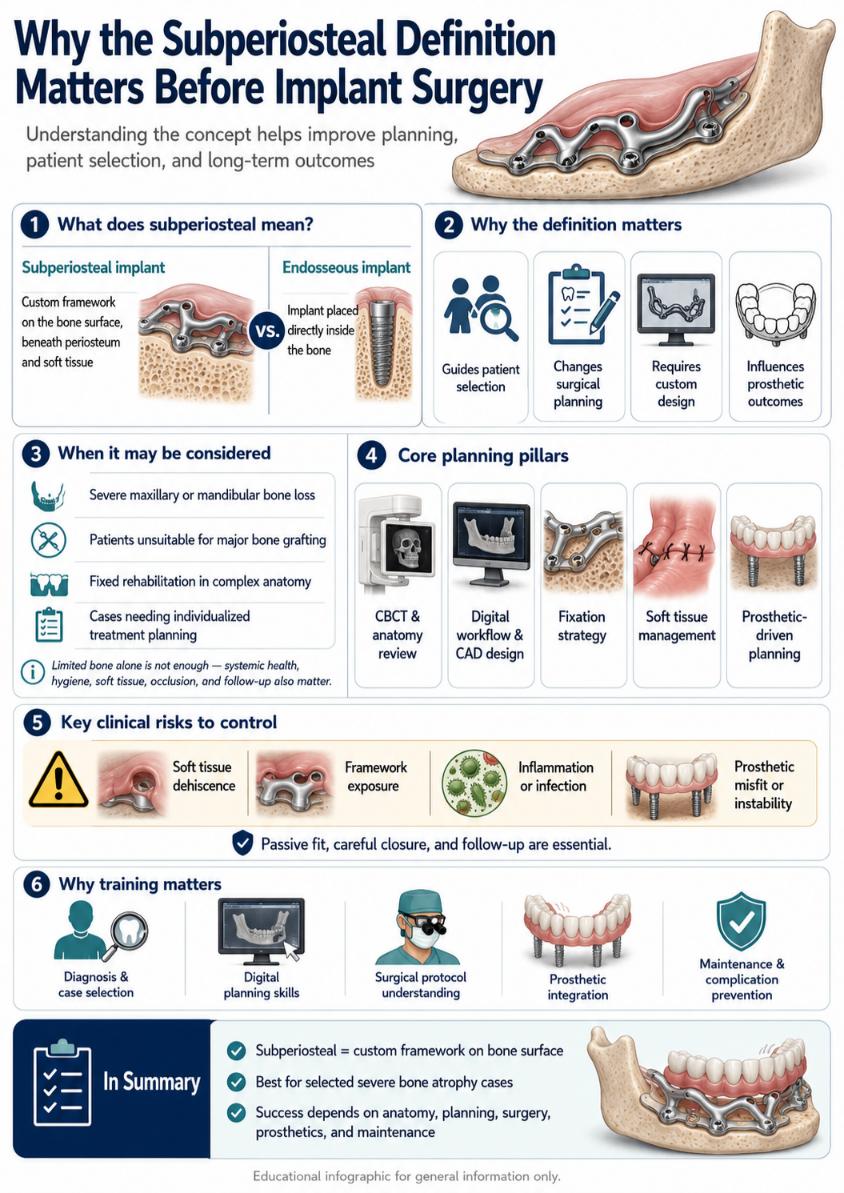
Typical indications may include patients with severely atrophic maxillae or mandibles, individuals who are not good candidates for extensive bone grafting, patients seeking fixed rehabilitation while avoiding major augmentation procedures, or cases where anatomical structures make conventional implant placement difficult.
However, indication must always be set carefully. The presence of limited bone does not automatically make a patient suitable for a subperiosteal implant. Clinicians must also evaluate systemic health, oral hygiene, smoking status, soft tissue quality, prosthetic expectations, occlusal conditions, and the patient’s ability to maintain long-term follow-up.
The procedure is highly dependent on precision. If the case is poorly selected, even a well-designed framework may be exposed to complications such as soft tissue dehiscence, inflammation, prosthetic misfit, mobility, or infection.
A different approach from conventional implants
Subperiosteal implants differ from traditional screw-type implants in both philosophy and execution. Conventional implants require sufficient bone volume for intrabony placement. When bone is insufficient, clinicians often consider bone grafting, sinus lifts, ridge augmentation, zygomatic implants, or other advanced techniques.
The subperiosteal protocol can reduce the need for extensive bone augmentation by using the available bone surface as the foundation for a custom framework. This does not mean the procedure is simple or risk-free. Fixation, passive fit, tissue coverage, occlusal distribution, and biomechanical stability remain critical.
Unlike standard implant placement, the focus is not only on drilling into bone, but on designing a structure that follows the patient’s anatomy and supports the future prosthetic rehabilitation. This is why prosthetic-driven planning is essential. The implant framework must not only fit the bone; it must also support the final restoration in a functional, hygienic, and durable way.
Digital planning and custom design
Modern subperiosteal implantology relies heavily on digital workflows. CBCT imaging, intraoral or facial scanning, CAD design, and sometimes biomechanical analysis help clinicians and engineers plan the framework before surgery. These tools allow the implant to be adapted to the patient’s anatomy with a high degree of precision.
Digital planning also helps determine fixation points, prosthetic emergence, soft tissue clearance, and the relationship between the framework and surrounding anatomical structures. This step is crucial because a poor design can lead to excessive pressure on soft tissues, insufficient stability, hygiene difficulties, or prosthetic complications.
A clear definition of the subperiosteal space guides the entire workflow. The framework must be planned to rest on bone while respecting the periosteum, mucosa, and biological requirements for healing. It is this relationship between anatomical understanding and digital execution that makes the approach both powerful and demanding.
Soft tissue management and risk control
One of the most important aspects of subperiosteal implant surgery is soft tissue management. Since the framework is positioned beneath the periosteum and covered by mucosa, tissue thickness, vascularization, flap design, and closure technique all play a decisive role in the outcome.
Common risks include exposure of the framework, wound dehiscence, inflammation, infection, and discomfort caused by inadequate tissue coverage or excessive tension. These risks can be reduced through careful planning, atraumatic surgical handling, passive closure, and appropriate postoperative monitoring.
This is why the subperiosteal definition matters clinically. It reminds the practitioner that the procedure is not only about mechanical stability. It is also about biological integration, tissue protection, and maintaining a healthy interface between the implant framework and the surrounding soft tissues.
Treatment timelines and rehabilitation
For selected patients, subperiosteal implants may offer a shorter treatment pathway compared with protocols requiring extensive bone regeneration. Because the approach can avoid major grafting procedures in certain cases, patients may benefit from fewer surgical phases and faster progression toward fixed rehabilitation.
However, timelines should always be communicated realistically. The speed of rehabilitation depends on case complexity, tissue healing, framework design, prosthetic planning, and the clinician’s protocol. A shorter treatment process should never come at the expense of biological safety or prosthetic quality.
Patients should understand that subperiosteal implants are custom-made solutions for complex anatomical situations. Their success depends not only on the implant itself, but also on diagnosis, design, surgery, prosthetics, hygiene, and long-term maintenance.
The importance of training and structured learning
Because subperiosteal implantology combines anatomy, digital planning, surgical technique, prosthetics, and risk management, structured training is essential. Clinicians need to understand not only how to place a framework, but why each step matters.
Training should cover patient selection, radiographic analysis, digital workflow, framework design, fixation strategy, soft tissue handling, prosthetic integration, complication prevention, and maintenance protocols. This is where specialized educational resources and expert-led programs can help bridge the gap between theory and clinical practice.
For clinicians who want to deepen their understanding of this approach, SUBPERIOSTEAL provides a focused environment dedicated to subperiosteal implant education, digital workflows, clinical protocols, and advanced rehabilitation strategies for severe bone atrophy cases.
From definition to clinical expertise
Understanding the subperiosteal definition is the first step, but true clinical expertise requires much more. The practitioner must translate the concept into precise diagnosis, appropriate indication, accurate digital planning, controlled surgical execution, and reliable prosthetic rehabilitation.
This shared understanding also improves communication between surgeons, prosthodontists, dental technicians, engineers, and patients. When all stakeholders understand what “subperiosteal” means and what it implies, the treatment plan becomes more coherent and predictable.
Although modern customized subperiosteal implants show promising potential for patients with severe bone atrophy, clinicians must remain aware that the technique requires careful case selection and long-term follow-up. It should be considered a specialized solution, not a universal replacement for conventional implantology.
Conclusion
The subperiosteal definition matters because it shapes every clinical decision that follows. It explains where the implant is positioned, how it differs from endosseous implants, why it may be indicated in severe bone atrophy, and what risks must be controlled.
Before performing the procedure, clinicians must understand the anatomical, biological, digital, surgical, and prosthetic implications of the subperiosteal approach. When this foundation is clear, the technique can become a valuable option for patients who cannot be treated predictably with conventional implants alone.
In complex implantology, definitions are not academic details. They are the starting point for safer planning, better communication, and more predictable treatment outcomes.